Polo Ralph Lauren Knitwear: Fit, Size & Details Check
- Published
- Revised
- Editors
- Marcus Hale · Editor-in-Chief
When buying autumn and winter knitwear, the easiest mistake isn't choosing the wrong color—it's treating product titles, reference prices, or brand categories as if they were confirmed product facts. This article is for buyers who are looking for Polo Ralph Lauren style knitwear on fashion-reps but still can't t
Editor score 4.2 / 5

When buying autumn and winter knitwear, the easiest mistake isn't choosing the wrong color—it's treating product titles, reference prices, or brand categories as if they were confirmed product facts. This article is for buyers who are looking for Polo Ralph Lauren style knitwear on fashion-reps but still can't tell whether the fit, size, and details will work for them. It organizes a pre-purchase checklist to verify these things.
This article was verified on October 17, 2026. Prices, stock, colors, sizes, sellers, shipping, taxes, and return conditions on the page may change, so always rely on the information shown on the product page and at checkout. This article does not claim that the editor personally purchased, received, or wear-tested the items, nor does it treat catalog images as physical QC evidence.
What This Polo Ralph Lauren Product Review Helps You Decide
The specific decision you need to make is: which autumn/winter knitwear candidates to keep, and what evidence to gather before pausing your order.
After reading, you should be able to do three things:
- Use the product page's actual measurements and your fit preferences to make a preliminary judgment on slim, regular, or relaxed fit.
- Distinguish between materials or construction details that are clearly shown in the catalog and product details that haven't been verified yet.
- Know what evidence to ask for when images, size charts, QC, and seller information are insufficient—rather than using the brand name or reference price as a substitute for judgment.
This article does not apply to situations where you need to confirm authenticity, official authorization, actual wool content, or final import taxes. The fashion-reps catalog records alone cannot prove those things.
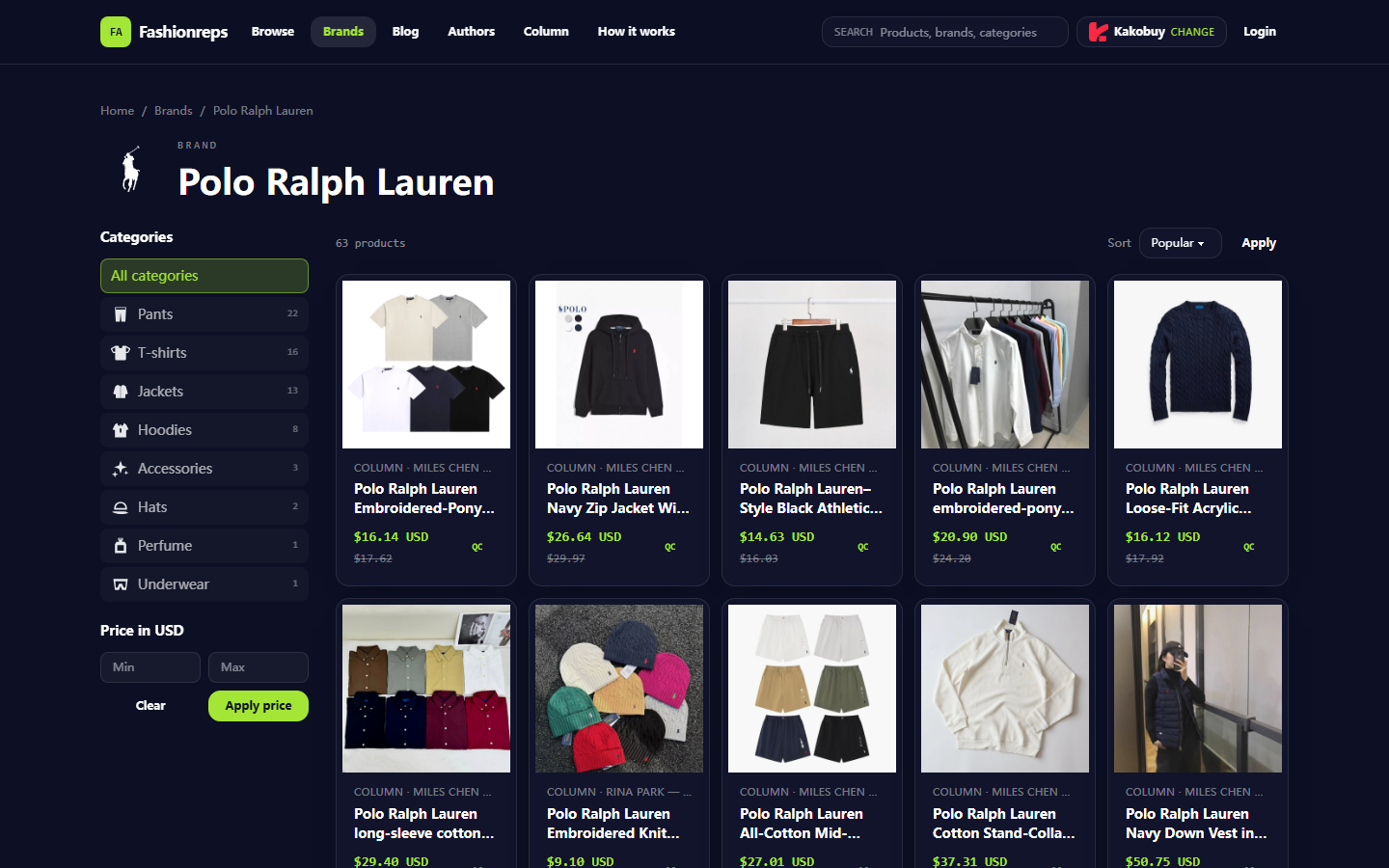
Pinning Down Specific Knitwear Candidates from the fashion-reps Page
On the fashion-reps Polo Ralph Lauren brand catalog page, you can start by pinning down these candidates to avoid constantly switching between products while browsing:
| Catalog Candidate | Page Visible Info | Still Needs Verification Before Buying |
|---|---|---|
| Loose-Fit Acrylic Crewneck Sweater | Relaxed-fit acrylic crewneck sweater, six colors, catalog reference price $16.12 | Actual sizes on the product page, body length, chest width, sleeve length, fabric composition, and stock |
| Cotton Stand-Collar Sweater | Cotton stand-collar sweater, eight colors, sizes S–XXL, catalog reference price $37.31 | Stand-collar height, zipper or closure type, whether different colors share the same size chart |
| White Wool-and-Cashmere Crewneck | White wool-and-cashmere crewneck knit, described as slim fit and ultra-fine knit, catalog reference price $61.19 | Specific wool/cashmere ratio, transparency, actual thickness, care instructions, and white stock |
This content is a summary of what was visible on the catalog page at the time and does not equal the full product page specs. The catalog also shows multiple clothing categories under the Polo Ralph Lauren brand, but you cannot assume from that alone that every candidate is suitable for autumn/winter, uses the same seller, or has the same QC conditions.
How to Check Product Page Specs, Colors, and Size Charts
First, check if the product page provides the product name, color options, size options, and a clear measurement chart. If there's only a category page title and no readable specs, you can at best build a candidate, but you cannot confirm sizing.
I recommend recording the following in order:
- Record the chest, shoulder width, body length, and sleeve length of a top you usually wear—ideally a knit with a similar fit measured flat.
- Compare the product page's flat measurements to your own garment; don't just go by height or weight and pick S, M, or L.
- Check whether the size chart notes measurement tolerance, units, and method. If centimeters and inches are mixed, convert to one unit before comparing.
- Keep separate notes for color and size stock. Six or eight colors means those are options, not that every color has a full size run.
- Check for cases where the same style has different batches, different fabrics for different colors, or different sellers.
If the product page only shows international sizes without body length, chest, and sleeve length, it's wise to keep the candidate but hold off ordering. For relaxed fits, you can't simply equate sizing up with a designed loose fit; shoulder line, armhole, and hem will all change the look. For slim, thin knits, chest ease and fabric stretch are especially important, and white versions need extra attention to sheerness.
Visible Details of Knit Structure, Neckline, and Cuffs
Images help assess construction, but they can only support "what is visible in the picture," not prove "what the item actually is." When verifying, pay attention to:
- Is the crewneck flat? Does the neck binding show obvious waviness or asymmetry?
- Can the stand collar stand naturally? Are there folds or bunching at the neck-shoulder seam?
- Are the ribbing on cuffs and hem even in width, and is there noticeable looseness or curling?
- Is the knit texture consistent? Do patterns, embroidery, or logo placement stay consistent across different images?
- For white or light knits, can you see the outline of inner layers, and is there visible sheerness under strong light?
These observations should only be recorded as image evidence—not as claims that you have touched the material, wear-tested it, or confirmed the construction quality. Names like acrylic, cotton, wool, and cashmere cannot be confirmed by appearance alone; ultimately, rely on the product page's composition information and necessary physical QC.
The Evidence Boundaries of Images, QC, and User Feedback
Product images on fashion-reps are suitable for confirming style direction and visible structure, but insufficient for confirming actual hand feel, warmth, shrinkage, or pilling resistance. A QC mark in the platform catalog does not mean this article has obtained an independent inspection conclusion for any specific item.
Before ordering, you can rank evidence by strength:
- Level 1: Product page text, size chart, colors, and stock—the basic evidence for building candidates.
- Level 2: Multiple angle images of the same product, used to check neckline, cuffs, hem, and logo placement.
- Level 3: Warehouse QC photos for your specific order, used to detect size, color, obvious stains, damage, and structural deviations.
- Level 4: Buyer feedback, but you must distinguish whether the feedback corresponds to the same product, same color, and same batch.
If there are no QC photos or reliable feedback for the specific item, avoid conclusions like "stable quality," "reliable warmth," "authentic," or "guaranteed not to shrink." When images are few, details are blurry, or feedback doesn't match the product, write that risk into your purchase decision instead of inferring quality from a higher reference price.
Fit Considerations for Autumn/Winter Commuting and Daily Scenarios
The relaxed acrylic crewneck is more suitable for buyers who want to layer a T-shirt, shirt, or thin base layer underneath, but actual warmth, static, and pilling still need to be supported by composition, thickness, and feedback. It may not be the best choice for those needing a crisp shoulder line or a formal office silhouette.
The key for the cotton stand-collar style is the neck structure and room to move. If the collar is high, it might add more dimension than a regular crewneck for commuting; but if the product page doesn't specify the closure type and collar measurements, you can't predict ease of putting on and taking off, nor confirm it's suitable for direct skin contact.
The white wool-and-cashmere crewneck's catalog description emphasizes slim fit and ultra-fine knit. It might work well with suits, jackets, or light layering, but thin knits have higher requirements for sizing, sheerness, snagging, and care. The specific wool/cashmere ratio isn't shown in the current catalog summary, so you can't judge warmth or feel from the name alone.
A more reliable approach is to define your scenario first, then revisit measurements and construction:
- Commuting and layering: Prioritize shoulder width, body length, cuffs, and room to move inside an outer layer.
- Daily wear as a single layer: Prioritize chest ease, sheerness risk, neckline fit, and hem recovery.
- Cold climates: Don't judge warmth by the "autumn/winter" tag alone; confirm thickness, composition, layering space, and local shipping season.
What Cannot Be Confirmed When Page Information Is Insufficient
Based on the currently visible catalog summary, the following cannot be directly confirmed:
- Whether the item is officially authentic, from an authorized channel, or exactly identical to a brand official style.
- The actual seller, shipping origin, stock quantity, and real availability of different colors.
- The specific ratio of wool, cashmere, cotton, or acrylic and the testing basis.
- Whether physical measurements match the size chart, and whether it shrinks, deforms, or pills after washing.
- Shipping costs, taxes, customs responsibility, return/exchange costs, and final delivered price after checkout.
- Whether a specific item has passed warehouse inspection for that particular order.
Regarding customs and fees, you should declare honestly according to the destination country's regulations, and confirm the route, tax responsibility, and restrictions provided by the platform and logistics provider. Do not reduce risk by under-declaring, splitting orders to avoid taxes, or evading inspection.
Pre-Purchase Risk Checklist
Before ordering, you can confirm item by item:
- Does the product page name match the catalog candidate?
- Are color, size, and stock clearly shown on the same page?
- Does the size chart include key data like chest, shoulder width, body length, and sleeve length?
- Is the material description specific, or just a vague fabric name?
- Are there sufficiently clear images of the neckline, cuffs, hem, and logo?
- Is seller information, shipping conditions, and return policy visible?
- Does the purchase price still match the current page? The catalog reference price is only a comparison baseline.
- Are you willing to accept the risk that the physical item may differ from images and size chart?
- Do you plan to request appropriate QC photos at the warehouse stage and allow time for handling issues?
- Is the shipping route, destination taxes, and customs paperwork confirmed?
Next Step: Gather More Evidence, Keep Candidate, or Hold Off Ordering
If you prefer a relaxed layered look, you can keep the acrylic crewneck candidate, but you must fill in actual measurements, color stock, and knit detail images. If you value a commuting silhouette more, prioritize checking the cotton stand-collar's shoulder width, collar structure, and room inside an outer layer. If you're considering the white wool-and-cashmere style, first gather evidence on composition ratio, transparency, care, and physical QC.
Only when the product page specs, colors and sizes, seller terms, and a workable QC plan are all clear should you proceed to ordering. If the page still lacks key measurements, material ratios, or return info, holding off is usually safer than guessing based on brand name and reference price. 🧶
This article doesn't offer a single "best pick" without evidence. A more reasonable conclusion is: a relaxed fit may give more layering room but also increases the risk of being too loose and size deviation; a thin wool-and-cashmere may give a lighter layered look but also increases sheerness, snagging, and care risks; a stand-collar style may suit commuting looks better, but collar comfort and construction still need support from the product page and QC. Which one suits you depends on your measurements, wearing scenario, acceptable evidence gaps, and destination country's delivery conditions. ✅
Community feedback 5 reviews
Reader score 4.2 / 5 (5 ratings)
- drewh5 / 5
Solid write up. Learning to read product titles as style references instead of confirmed facts changed how I shop. Sticking to that rule from now on.
- Sofia_R4 / 5
Been burned once treating a listing photo as the real product, so this rings true. Now I look at cuff ribbing and collar shape before anything else.
- tommyknit3 / 5
helpful but I wish there were actual size charts for the knitwear. The cable knit runs small in my experience, size up one if you want it roomy.
- ElaineW5 / 5
The part about reference prices being misleading is so true. A sweater listed as Polo style is often just the vibe, not the real label. Check the stitching and the pony logo placement closely.
- harry_m4 / 5
Good reminder that the title doesn't guarantee the actual fit. I always ask for the shoulder and chest measurements laid flat before ordering knitwear, saves me every time.