Mammut Jacket Review: Assessing Fall-Winter Layering Fit
- Published
- Revised
- Editors
- Marcus Hale · Editor-in-Chief
This article solves a specific buying task: when you see a [mammut](https://fashion-reps.net/brand/mammut) jacket page but can't tell if it's meant for standalone wear, fall-winter layering, or only as a lightweight mid-layer, how to make your next decision based on page specifications, images, QC info, and size charts. This article only discusses visible evidence on the page and editorial judgment, not treating product descriptions as test results, and not replacing a re-check of the current va
Editor score 4.2 / 5
This article solves a specific buying task: when you see a mammut jacket page but can't tell if it's meant for standalone wear, fall-winter layering, or only as a lightweight mid-layer, how to make your next decision based on page specifications, images, QC info, and size charts. This article only discusses visible evidence on the page and editorial judgment, not treating product descriptions as test results, and not replacing a re-check of the current variant before ordering.
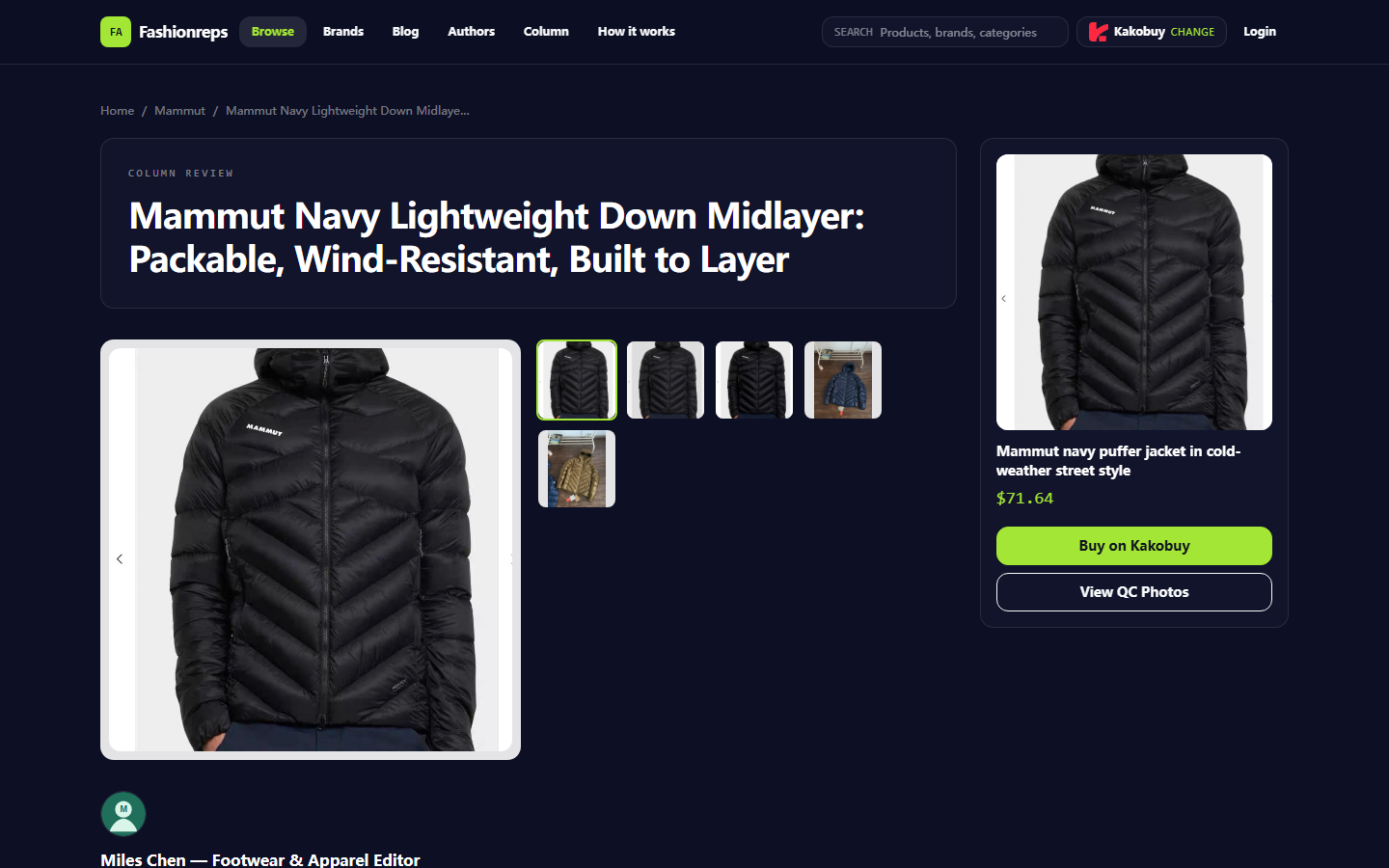
Page records show this jacket is described as a navy lightweight down mid-layer, with a reference price of $71.64; final product price, service fees, and international shipping need to be confirmed on your chosen shopping agent website. The QC photo update record for the related page is September 26, 2026. Prices, stock, variants, and shipping may change; readers should re-check before actually ordering.

What buying task does this mammut jacket review solve?
The core question is not "Is this jacket good?" but "Can it meet your fall-winter wearing position?" If you need a low-loft, easy-to-pack insulation layer that can go under a hardshell, the page information is enough for initial screening; if you need an outer layer that can independently handle severe cold, continuous rain, or high-intensity outdoor activities, current evidence is insufficient to support that judgment.
After reading, you should be able to do three things:
- Judge whether it's closer to a lightweight mid-layer or a heavy winter outerwear.
- Plan mid-layer and outer layer combinations based on fit, collar, placket, pockets, and hem information.
- Know what to check further or postpone purchase when size, material, protection performance, or QC evidence is insufficient.
This article does not apply to those who need precise judgment on actual loft, fill weight, lab wind/waterproof data, or need to confirm workmanship of a specific batch. Page descriptions can only state what the seller or product information writes, not prove actual performance after wearing.
Review scope: page specs, images, QC, and verifiable feedback
This judgment is based on visible information on the fashion-reps product page. The page positions this item as a lightweight down mid-layer, listing thin, compressible, wind-resistant fabric, V-shaped quilting, zippered hand pockets, and elastic cuffs. The page also hints it can be worn alone in spring and fall, or as an inner layer under a hardshell for winter hiking, climbing, or commuting.
This information supports "usage positioning," but cannot directly infer insulation level or extreme weather performance. The page mentions the fabric has light rain splash protection, not full waterproofing; therefore a more cautious understanding is that it leans toward wind protection and light warmth, not a rain shell. 🌧️
The page also references public materials and user feedback from other Mammut down products for brand-related care and durability background, but these do not equal item-by-item testing of this jacket. Especially the fit, fill, and fabric treatment of other models cannot be directly applied to the current item.
How to read jacket fit, color, and size info
For color, the page describes the current style as navy. Dark colors are generally easier to combine with black, gray, olive, and denim items, but this is only a styling judgment, not a guarantee that colors are identical across batches or display devices. Before ordering, always base on current variant images and available colors.
Size is the part that needs separate checking the most. The page clearly reminds that Mammut sizing may vary between models: feedback from buyers mentions that for the same size M, one model's sleeve length is noticeably larger, while another fits well. This feedback only shows that you cannot default to your usual brand size for the current model, not that this jacket is definitely larger or smaller.
It is recommended to check in the following order:
- Find the size chart for the current item, not just the brand's general size chart.
- Compare your shoulder width, chest, sleeve length, and usual mid-layer thickness.
- If you plan to put it under a hardshell, confirm there is still room for movement at shoulders and armholes, while avoiding excessive looseness that causes outer layer friction or bulging.
- If planning to wear alone, pay attention to body length and hem position, ensuring it won't be too short to expose the mid-layer, nor too long to affect sitting or cycling.
- Compare QC photos to confirm the actual variant matches the main image, color, and structure on the page.
Do not choose M just because you "usually wear M." For those who need layering, the right size is not bigger is better, but a balance among mobility, sleeve length, shoulder smoothness, and outer layer compatibility. 📏
How collar, placket, pockets, and hem structure correspond to fall-winter layers
The structural information listed on the page can help judge its position in a layering system.
If the collar is of moderate height, it usually helps reduce cold wind at the neck and makes layering with crewneck sweatshirts, fleece, or thin knits easier. But the current page does not provide measurements of collar height, fill thickness, or actual fit, so further claims about insulation cannot be asserted.
The main zipper is an important connection point for fall-winter layering. The page describes the main zipper as smooth but provides no long-term durability testing. Before purchase, check in QC images whether the zipper teeth are aligned neatly, the placket is straight, and no obvious waves or misalignment after zipping.
Zippered hand pockets are more suitable for commuting, walking, and daily activities. They can hold keys, cards, or small thin items, but the page does not give pocket dimensions, internal compartments, or weight capacity, so do not assume they can reliably hold large phones, thick wallets, or lots of gear.
Elastic cuffs help reduce cold air entering at the wrist and make cuffs fit inner layers more easily. But if your arms are long, elastic cuffs cannot compensate for insufficient sleeve length; always refer to the size chart and QC images.
The hem determines compatibility with outer layers. A lightweight mid-layer usually needs to lie flat under a hardshell or loose jacket; excessive hem wrinkles cause bunching, while too tight can restrict sitting, arm raising, or increase zipper pressure. The page does not provide hem width or drawstring details, so this part can only be further confirmed through current style images.
Practical selection boundaries for pants, shoes, and mid-layer combinations
If using it as a fall-winter mid-layer, the key is to control overall thickness, not keep adding layers. A navy jacket can combine with black straight pants, dark gray cargo pants, dark jeans, or low-saturation outdoor pants. For shoes, prioritize hiking shoes, trail runners, or casual sneakers with simple colors and moderate volume, keeping visual focus on the jacket and layering relationship.
Different usage scenarios can be judged as follows:
- Commuting: wear a lightweight windbreaker over the jacket, focusing on sleeve length, collar friction, and hem length when sitting.
- Fall standalone: pair with thin long-sleeve, knit, or light sweatshirt, focusing on chest room and pocket practicality.
- Winter outdoor: place it between a base layer and hardshell, focusing on shoulder mobility, cuff compatibility, and whether the outer layer compresses the quilted areas.
- Low-temperature static activities: do not judge insulation level solely by the word "down"; must check fill weight, fill ratio, applicable temperature, or more complete specs.
The page describes it can be worn alone in spring, fall, and early winter, and as a mid-layer in deep winter activities. This is usage positioning from product information, not a temperature promise after independent testing. For strong wind, continuous rain, wet snow, or prolonged static environments, additional outer layers and more reliable insulation evidence are needed. 🧥
How to record page evidence and editorial judgment separately
To avoid writing inferences as facts, current information can be divided into three levels:
| Information level | Judgment supported on current page | Content to check before ordering |
|---|---|---|
| Page explicit description | Navy, lightweight down mid-layer, wind-resistant fabric, compressible, V-shaped quilting, zippered pockets, elastic cuffs, light rain splash protection | Whether current variant still has the same configuration, stock and price changes |
| Page references or background | Other Mammut down products involve anti-leak down treatment, water-repellent fill, and care precautions; some feedback mentions size differences between models | Whether current model uses same treatment, actual size matches reference model |
| Editorial judgment | More suitable as lightweight mid-layer, fits fall-winter layering system, not directly a full rain shell or deep winter heavy outerwear | Fill weight, specific materials, temperature performance, durability, and current batch workmanship |
This distinction is important. For example, the page mentions light water repellency, but that doesn't mean the whole jacket is waterproof; it mentions compressibility, but that doesn't mean long-term storage compressed won't affect fill condition; it shows QC photos, but that doesn't mean all same items have identical workmanship.
If you see stitching, quilting, zipper, cuff, or color differences in images, record them as "current image visible phenomena," not upgrade to "problems existing in the whole batch." Similarly, user feedback from other models can only serve as risk hints, not replace physical inspection of the current style.
What cannot be inferred when material, insulation, or protection performance is unspecified
The following conclusions currently cannot be confirmed from page info alone:
- Cannot confirm specific fabric fiber, fabric weight, or complete windproof rating.
- Cannot confirm down fill weight, down content, or loft.
- Cannot confirm applicable minimum temperature.
- Cannot confirm the garment is waterproof; page only supports light rain splash protection description.
- Cannot confirm current model definitely doesn't leak down. Background materials actually hint that high-friction areas like cuffs and pockets may have down leakage risk.
- Cannot confirm frequent washing won't affect anti-leak treatment. Page care tips are to reduce washing frequency and avoid dry cleaning that may damage the down-proof coating.
- Cannot confirm current item shares same fit or sizing pattern with other Mammut models.
Therefore, purchase decisions should revolve around "is evidence sufficient for my use," not brand name or a single adjective on the page. 🧾
Final action: check variant, supplement evidence, or postpone purchase
If your goal is to find a lightweight, packable jacket that works in fall-winter layering, this page can be an initial candidate. Its visible information supports the positioning of "lightweight down mid-layer," especially suitable for those who need extra warmth under a hardshell, or want to wear alone in spring and fall.
Before ordering, complete the following checks:
- Confirm current color, size, and stock are still available.
- Open the current size chart, choose based on chest, shoulder width, sleeve length, and layering plan, not directly use your usual size.
- Check QC photos for obvious abnormalities in main zipper, quilting, cuffs, pockets, and hem.
- Re-confirm on your chosen shopping agent website the product price, service fees, international shipping, route restrictions, and possible taxes.
- If you need rain protection, deep winter static warmth, or long-duration high-intensity outdoor use, supplement material, fill weight, and protection performance; if not found, postpone purchase.
- After purchase, follow down care instructions to reduce unnecessary washing, and avoid treating dry cleaning suggestions as default.
In terms of cost and risk, the main benefit of this lightweight mid-layer is smaller volume, easy packing, and possibly reduced bulk when layering; main risks are size differences, durability of lightweight fabric at friction points like cuffs and pockets, and insufficient insulation and protection parameters on the page. It is more suitable for those willing to check sizes, accept information boundaries, and incorporate the jacket into layered outfits; not suitable for those expecting one garment to simultaneously serve as a heavy winter jacket, full rain shell, and long-term durable gear.
When ordering through fashion-reps, the purchase button will take you to your selected shopping agent, and final costs and international delivery conditions are subject to the agent's page. Do not skip re-checking variant, size, QC, and shipping conditions just because the reference price or page positioning seems right.
Community feedback 5 reviews
Reader score 3.8 / 5 (5 ratings)
- d_okoro3 / 5
Solid but a little long-winded in the intro. The size chart section is the useful part. One thing I'd want is a note on how to read sleeve and pit-to-pit numbers together, since that combo tells you way more about layering room than the chest tag alone. Otherwise no complaints, the layering fit question is exactly what I searched for.
- Petra Lindqvist4 / 5
Good breakdown of standalone vs mid-layer use. I'd add that if you run hot you can often skip the heavy mid-layer and just run a base plus a shell, which changes what size you need. Took me two winters to figure that out the hard way. The editorial-judgment framing here is honest, appreciate that it doesn't pretend to be a lab test.
- notabot_james5 / 5
finally someone who says the quiet part out loud, you cannot judge a jacket from the marketing copy alone. The QC photo angle is underrated. If the page has real QC shots you can usually spot if the shoulders are cut narrow, which kills layering. Bookmarked this for when I pull the trigger on a hardshell.
- Kasia_W3 / 5
Decent read but I wanted more on the actual fit numbers. Like what does the sleeve length look like on a 6ft frame? I get that you're only going off page specs and images, fair enough, but for layering the arm length matters more than anything. Still, the reminder to recheck the current listing before buying makes sense since sizes shift between seasons.
- trail_mike774 / 5
Been eyeing a Mammut shell for winter layering and this actually answered the thing I keep getting stuck on. Most product pages just show the jacket on a model with zero context, so you can't tell if it's a standalone piece or a mid-layer. The bit about checking the size chart against your actual chest measurement instead of the tagged size is real talk. I sized up on my last shell and regretted it.