Jordan Multi-Pair Savings: Compare Item and Shipping Costs
- Published
- Revised
- Editors
- Marcus Hale · Editor-in-Chief
 # Jordan Multi-Pair Savings: Compare Item and Shipping Costs If you're planning to pick out multiple pairs of Jordan on [Fashionreps](https://fashion-reps.net/), the real question isn't "does buying more always make it cheaper?" but rather: under the same destination, same size requirements, and same shipping conditions, can combining orders offset the additional item c
Editor score 4.2 / 5

If you're planning to pick out multiple pairs of Jordan on Fashionreps, the real question isn't "does buying more always make it cheaper?" but rather: under the same destination, same size requirements, and same shipping conditions, can combining orders offset the additional item costs and still be worthwhile once payment, packaging, and shipping fees are added in.
This article handles only one task: comparing the item costs and shipping costs for multiple pairs of Jordan to determine whether adding another pair or combining orders offers verifiable savings conditions. After reading, you should be able to build an item-by-item accounting table and decide whether to continue comparing, keep candidates, or stop adding pairs.
Cases that don't apply include: no clear destination, no confirmed purchasable sizes, no access to valid product information, or only knowing the listed price without any service fee and shipping cost conditions. In such cases, you can only set up a verification workflow, not claim how much money you've saved.
Verification date: October 9, 2026. The product names, reference prices, and size information in this article come from visible page samples in Fashionreps' Jordan brand catalog; discounts, inventory, service fees, packaging fees, and shipping fees are not confirmed with current quotes in the provided materials.
Recording each pair's current price, size, and quantity from Fashionreps product pages
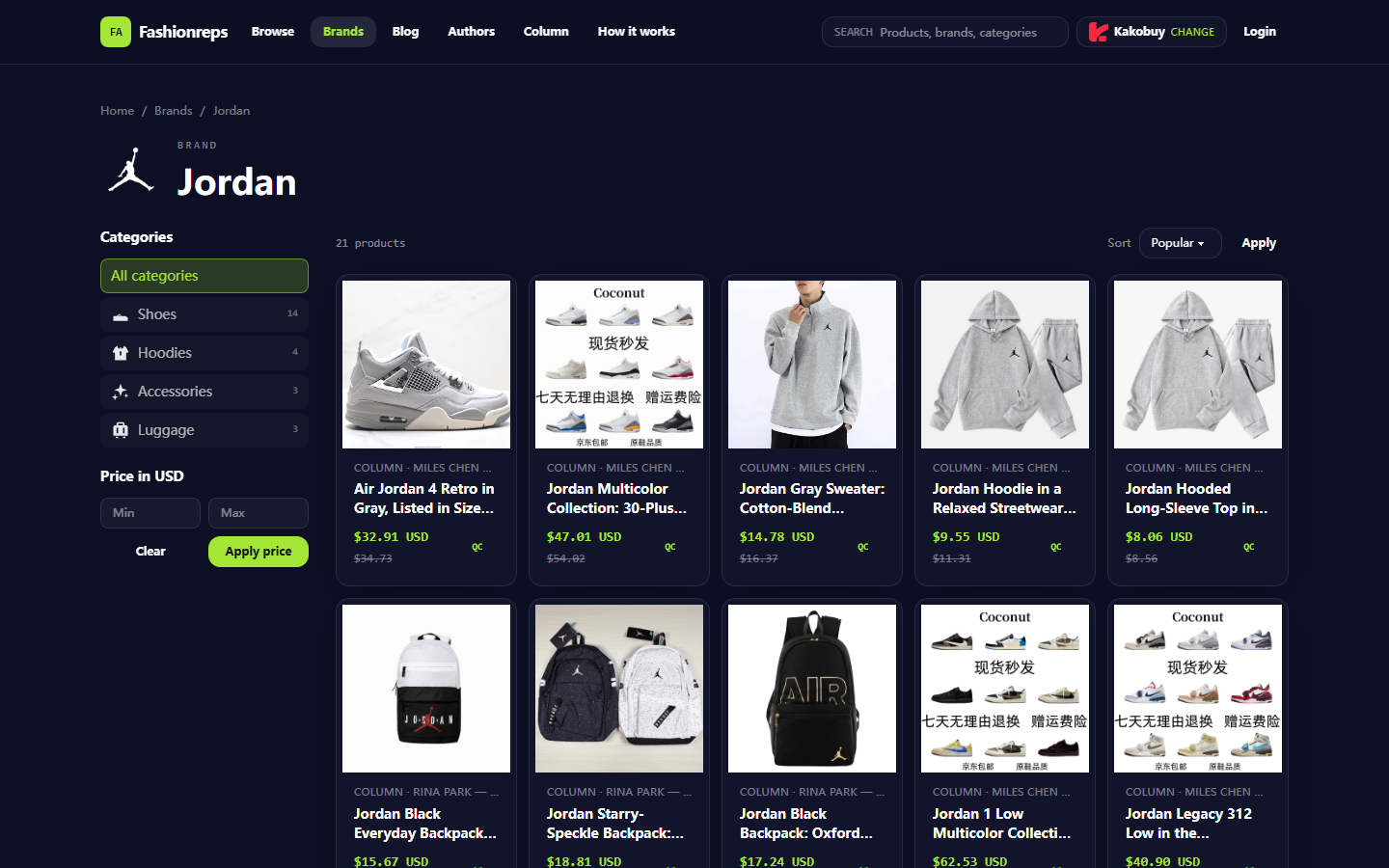
Fashionreps' Jordan brand catalog displays various shoe models, but the "Reference price" in the catalog can only be taken as a recorded page value and cannot be directly equated to the final settlement amount. The page also notes that the purchase button will lead to the user's chosen shopping agent, where orders, payment, and shipping are handled by the agent's website. Therefore, when comparing multiple pairs, you must record the product page price separately from the subsequent agent fees.
Visible Jordan shoe samples in the catalog include:
- Air Jordan 4 Retro in Gray, listed in sizes 36–47, with a reference price of $32.91.
- Jordan Multicolor Collection, listed as adult mid-top styles, with a reference price of $47.01.
- Jordan 1 Low Multicolor Collection, listed in sizes 36–46, with a reference price of $62.53.
- Jordan Legacy 312 Low White/Red Chicago, with a reference price of $40.90.
- Gray Jordan 4 Retro mid-top shoes, with a reference price of $47.01.
- Jordan 1 Low Brown, with a reference price of $34.48.
- Jordan 1 Low "Reverse Mocha" Style, listed in sizes 35–45, with a reference price of $28.21.
These records can help you form a candidate list, but they don't prove that inventory still exists or that every size listed on the page can be purchased at checkout. First record the target size for each pair, then confirm whether the product page is still accessible, whether the product name is clear, and whether the page has enough information to support an ordering decision. 👟
| Candidate item | Page reference price | Visible size info | Verification focus |
|---|---|---|---|
| Air Jordan 4 Retro in Gray | $32.91 | 36–47 | Target size, current page, and agent orderability status |
| Jordan 1 Low Multicolor Collection | $62.53 | 36–46 | Specific color, target size, and page status |
| Jordan Legacy 312 Low White/Red Chicago | $40.90 | Not listed in page sample | Confirm size and purchasability before checkout |
| Jordan 1 Low "Reverse Mocha" Style | $28.21 | 35–45 | Style identification, target size, and whether page is still valid |
A "previous reference price" for the same item cannot be directly treated as an achieved discount. For example, some items in the catalog show a previous reference price, but that does not mean the current checkout page offers a discount, nor does it guarantee an automatic extra discount when buying multiple pairs. 📌
Checking visible offers, applicable thresholds, exclusions, and validity periods
Whether buying multiple pairs can save money depends first on whether the offer actually exists, whether it applies to the target items, and whether it can be used under the same comparison criteria. It is recommended to check in the following order:
- Record the current reference price shown on the product page, and keep the product name and target size.
- Check whether there is a clear discount amount, discount percentage, usage threshold, or applicable item range.
- Confirm whether the offer is a price adjustment at the item level or a service discount provided by the shopping agent, payment method, or shipping route.
- Record the validity period, usage limit, excluded items, and whether it can be stacked with other offers.
- If the page only shows the current reference price and previous reference price without clear promotion rules, mark the offer column as "unconfirmed".
This material does not provide verifiable current multi-pair offer rules, agent service fees, or logistics discounts. Therefore, you cannot calculate realized savings based on the difference in reference prices in the catalog, nor can you guarantee that buying multiple pairs of Jordan at once will produce a discount. ✅
Standardizing item quantity, destination, packaging, and shipping conditions before calculation
When comparing individual orders and combined processing, you must fix the variables first. Otherwise, even if two plans show a price difference, they may be comparing different item quantities or different service conditions.
It is recommended to standardize the following:
- Item quantity: for example, two pairs, three pairs, or four pairs; you cannot directly compare a one-pair plan with a multi-pair plan.
- Specific items: record the style, color, and target size to avoid mixing different price tiers.
- Destination: different countries or regions may have different agent services and logistics routes.
- Packaging method: confirm whether to keep the shoe box, whether extra protection is needed, and whether charges are based on actual weight or volumetric weight.
- Shipping timing: logistics quotes and available routes may change at different times.
- Exchange rate and payment method: standardize the currency and record possible fees from currency conversion or payment platforms.
- After-sales conditions: if a single item has an issue after combining, confirm whether it will affect the entire package processing or return/exchange arrangements.
Especially avoid a common misjudgment: directly treating the reduction in repeated handling fees from combining items as total savings. Combining may also increase package weight, volume, declared value, and single-loss risk. 📦
Separately comparing costs of individual orders vs. combined processing
Total cost can be broken down into four parts: item cost, agent or service cost, packaging handling cost, and final shipping cost. To compare two plans, you should use the same item combination and destination.
When processing multiple pairs individually, you can use the following approach:
Total cost of individual plan = sum of each pair's item price + sum of per-order service fees + sum of per-order packaging fees + sum of per-order shipping fees + payment or exchange rate fees
Total cost of combined plan = sum of multiple pairs' item prices + one or more service fees + combined packaging fee + shipping fee for combined package + payment or exchange rate fees
Combined savings = total cost of individual plan − total cost of combined plan
Only when the combined savings is greater than zero and the added risk is within your acceptable range does the combined plan make economic sense. If service fees, packaging fees, or shipping fees have no quotes, mark the result as "pending confirmation" and do not fill in estimated numbers to pass off as actual savings.
You can build the following records for each candidate combination:
- Item amount: add up each pair, do not treat the previous reference price as a discount.
- Service fees: record per-order fees, combined packaging fees, or other handling fees separately.
- Packaging fees: record the cost differences for keeping the shoe box, removing the shoe box, reinforcement, or special packaging.
- Shipping fees: record quotes under the same destination and same route.
- Payment fees: record costs from currency exchange, bank cards, payment platforms, or other surcharges.
- Unconfirmable items: clearly write out items for which no quote has been obtained; do not replace unknown numbers with zero.
If the item prices for two pairs are $32.91 and $28.21, the known item amount is $61.12; this is only the arithmetic sum of the page reference prices, excluding service, packaging, shipping, payment fees, taxes, or other possible costs. This figure can be used as a starting point for comparison but cannot be stated as the landed price or final savings. 🧮
Recording exchange rates, payment fees, packaging fees, and unconfirmable items
When the product page displays prices in US dollars and your payment account uses another currency, you should at least record:
- The exchange rate or currency conversion channel used.
- The exchange rate verification date.
- Whether there is a fixed payment fee or a percentage-based fee.
- Whether exchange rate changes would alter the ranking of candidate combinations.
- Whether item amounts and shipping amounts use the same settlement currency.
If service fees or shipping fees are calculated by the shopping agent on subsequent pages, you cannot use figures from other articles, old orders, or unconfirmed experience as substitutes for current quotes. Different destinations, packaging, routes, and times can all cause changes.
Taxes and customs costs also cannot be defaulted to zero. They should be verified according to the destination country's applicable rules and official information provided by the agent, and you should not use under-declaration, splitting orders to avoid taxes, or evading inspections to create "savings". If this part cannot be confirmed, it should be marked separately in the comparison table rather than hidden outside the item prices.
Rewriting into a verification workflow when there is no current offer or quote
When the Fashionreps product page does not show a current multi-pair offer, or the agent page has not yet provided a complete shipping quote, you can rewrite the article's conclusion into an executable verification workflow:
- From valid product pages, record the name, reference price, target size, and quantity of each pair of Jordan.
- Keep only pages that are still accessible, have clear product names, and sufficient visible information.
- Enter the same shopping agent process and record the actual item-level amounts or pending confirmation status.
- Using the same destination and same packaging conditions, separately ask for quotes on individual processing and combined processing.
- Record service fees, packaging fees, shipping fees, payment fees, and taxes in separate columns.
- Mark all unquoted items as "pending confirmation" and do not fill in with guessed numbers.
- Recalculate the total cost of both plans and check whether the acceptable risk level has changed.
- If combining only reduces a small fixed fee but significantly increases package value or shipping risk, stop adding pairs.
The value of this workflow is to transform "buying more might be cheaper" into verifiable conditions, rather than misreading catalog price differences as final discounts.
Using a savings conditions checklist to decide whether to add, keep candidates, or stop comparing
You can check item by item before placing an order:
- Target items and sizes are confirmed, and the pages are still valid.
- Item quantities are exactly the same in both plans.
- Offer rules have clear amounts, thresholds, validity periods, and exclusions.
- Agent service fees have been quoted separately.
- Packaging method and shoe box handling conditions are consistent.
- Shipping destination, route, and billing conditions are consistent.
- Exchange rate and payment fees have been recorded.
- Taxes and customs responsibilities are not ignored.
- The added package weight, volume, value, and single-loss risk after combining are acceptable.
- Return/exchange or after-sales handling will not become unclear due to combining.
Only when the total cost of the individual plan is higher than the combined plan, and the relevant quotes and applicable conditions have been verified, can the combined plan be considered to have savings conditions. If currently only item reference prices are available, the safest decision is to keep the candidates, gather quotes, and then compare, rather than adding pairs just to reach a quantity.
The conclusion is simple: whether buying multiple pairs of Jordan saves money cannot be determined solely by "buying more" or the difference in reference prices in the catalog. You need to simultaneously check item amounts, offer rules, service fees, packaging, shipping, exchange rates, payment fees, and destination country taxes. Savings amounts should be based on actual quotes for two complete plans; the added risk is mainly higher package value, weight, volume, and single-loss exposure. It is suitable for buyers who have confirmed their size, destination, and agent quotes, and can accept the risk of combined packages; it is not recommended for situations where offers are unconfirmed, shipping costs are unknown, sizes are not verified, or the only purpose is to meet a quantity threshold.
Article image
Agent platform shopping FAQ
1. What product categories can be seen in the spreadsheet at hipobuy-sheet.com?
The spreadsheet at hipobuy-sheet.com includes shoes, clothing, bags, jewelry accessories, sweatshirts, perfumes, hats, scarves, belts, and a variety of household daily items.
Community feedback 0 reviews
No approved reviews yet.