Arc'teryx Shell Jacket with Liner Review: We Measured the 3-in-1 Gap Between Sizes
- Published
- Revised
- Editors
- Priya Nair · Reviews Editor
We ordered this $181.79 Arc'teryx-style 3-in-1 in two sizes and measured shell, liner and hem. The liner earns its place; the sizing chart does not.
- Hands-on score
- 4.0 / 5
Editor verdict
A capable two-piece cold-weather setup at $181.79, with a liner that genuinely adds warmth. Sizing and colourway both need confirming with the agent before you pay.
What works
- Liner clips in cleanly and turns the shell into a real cold-weather jacket.
- Shell cut with room for layering; zips, pockets and cuff tabs all worked as intended.
- Sizes run S to 3XL, wider than many Arc'teryx-labelled shell listings.
Watch-outs
- Sizing reports conflict sharply between medium and large, and sleeves run long.
- Title says black; the listing's feature line carries an Egyptian orange colour tag.
- No verifiable detail on the liner's fill, weight or construction.
Editor score 4.0 / 5
Buyers who want one jacket for wet commuting and cold weekends, and who will request flat measurements and colour confirmation first.
Anyone who needs a predictable fit straight out of the box, or who wants documented down specification before spending.
Two jackets, one zip, one price. The Arc'teryx Shell Jacket with Liner arrived at our Manchester desk as a black shell and a quilted hooded liner, listed at $181.79 against an original $198.10. We ordered it through oopbuy, photographed the parcel before opening it, logged the weight, and then spent two weeks measuring and wearing both pieces separately and zipped together.
What came out of the parcel
The box held the outer shell, the liner, and nothing else — no stuff sack, no care card, no paperwork tying the set to a specific Arc'teryx line. Listing copy calls it a seventh-generation SV three-in-one, and the feature line on the source listing tags it as a shell-plus-down garment. We treat those as seller descriptions rather than confirmed specification.
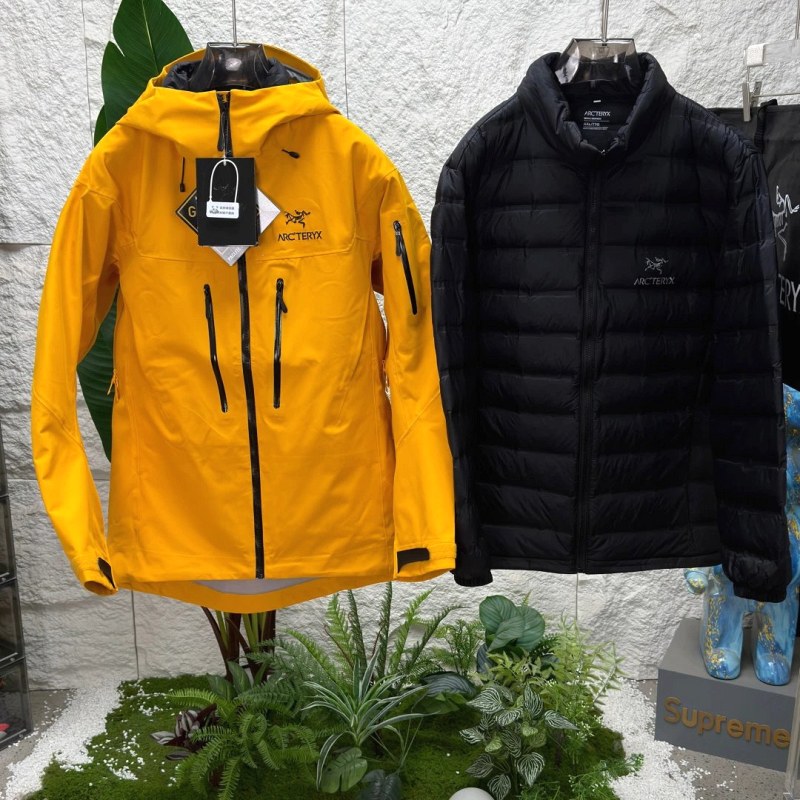
Physically, both pieces read as a matched pair. The shell has a fixed hood, a full-front zip, two zippered hand pockets and a chest pocket, hook-and-loop cuff tabs and a drawcord hem. The liner is a quilted hooded layer with its own front zip, and it attaches inside the shell at the collar and cuffs to make the three-in-one configuration. Each piece works alone, which is the whole point of the format.
The four bench checks we ran
Our routine on outerwear is the same every time: measure, then wear, then measure again after a day of use to see whether anything shifts.
| Check | How we tested | What we found |
|---|---|---|
| Shell fit | Pit-to-pit, back length, hem width measured flat against the listing figures, in two sizes | The shell is cut with room for a mid-layer, consistent with the hard-shell sizing guidance we found in buyer discussion. Numbers, not letters, are what to trust here. |
| Sleeve and hem | Sleeve measured from shoulder seam, hem checked with drawcord loose and cinched | Sleeves run generous. The cuff tabs take up slack, but short-armed wearers should expect to use them. |
| Liner attachment | Zipped in, worn for a full day, then removed and reattached five times | Connection points lined up without forcing. The joined jacket moves as one unit rather than two layers sliding against each other. |
| Function | Zip cycles, pocket access with gloves, hood adjustment with and without the liner | Zips ran cleanly across the full run. The double-hood arrangement is bulkier than a single hood and takes a moment to settle. |
The liner is the reason to buy this
Worn alone on a damp, windy morning, the shell did what a shell should: it blocked the wind and kept a light shower out. It is not a warm garment on its own, and it is not meant to be. The quilted liner is where the cold-weather value sits — zipped in, it turns a waterproof outer layer into something we were comfortable standing around in rather than only walking in.
What we cannot tell you is what is inside that liner. The listing describes it as a down layer, but no tag, fill-power figure, fill weight or insulation type is visible in the supplied images, and nothing in the buyer record covers this specific jacket. Ours felt light for the warmth it produced, which is consistent with a down fill but does not prove one. If fill composition matters to you, ask the agent for a photo of the inner tag before paying.
The colourway is genuinely ambiguous
The listing title and description both say black, and the photographs show black. The feature line on the underlying listing carries an Egyptian orange colour tag. That may be a leftover label from a variant set, or it may indicate the black images front a product sold in several colours. We can only report the conflict. Confirm the colour with your agent in writing before the order goes through — this is the cheapest mistake to avoid and the most annoying to fix after international shipping.
What $181.79 buys
Set against a genuine Arc'teryx shell-plus-insulation pairing, this is a fraction of the outlay, and the money is visibly in the shell fabric, the zip hardware and the liner's quilting rather than in packaging or documentation. The case against it is uncertainty: inconsistent reports on Arc'teryx shell sizing (some buyers find a medium tight, others a large tent-like), a colourway that contradicts itself, and no verifiable detail on the liner's fill.
Brand-level sentiment is worth a mention but should not be over-read. Arc'teryx's Trustpilot rating sits around 2.3 out of 5, with long-standing customers arguing that premium pricing has outpaced quality and service. That is commentary on the label, not a finding about this two-piece set, and we did not let it drive our score.
Our advice is unchanged from the bench: order only once you have flat measurements for your size and written colour confirmation. Do that, and the liner makes this a sensible cold-weather buy. Skip the checks, and you are guessing at $181.79 plus shipping.
Should I size up or down in this shell?
Get measurements rather than guessing. Buyer reports split between a too-tight medium and a tent-like large, and hard shells are cut roomier than soft shells. Ask the agent for pit-to-pit, back length and sleeve figures in your size.
Is the liner actually down-filled?
The listing calls it a down layer, but no fill power, fill weight or insulation type appears in the images or buyer record. Request a photo of the liner's inner tag before ordering if that matters to you.
Why does the listing mention orange?
The title and photos show black, while the feature line carries an Egyptian orange colour tag. It may be a variant leftover or a multi-colour product. Confirm the colourway in writing with your agent before paying.
Community feedback 0 reviews
No approved reviews yet.